Grimsel Pass history
Early days
The Alpine crossing from Oberhasli to Goms was probably already known to the aborigines (Celtic finds near Guttannen). In Roman and early Germanic times, this Alpine crossing was already a trade route.
The name Grimsel probably goes back to Grimiso, i.e. Grimo’s land. The first name changed to Grimiso in Gallic (formerly still spoken in Valais). The Valais village near Sion is probably called Grimisuat for a similar reason.
Middle Ages: North-South traffic
In the Middle Ages, the Grimsel played an important role in north-south traffic. From Brugg via Lucerne, this is the shortest route to Milan. Advantage over the Gotthard route: there are no obstacles such as the “sliding footbridge” in the Schöllenen. Disadvantage compared to the Gotthard route: no single-pass routes to Italy and topographically difficult and steep terrain. Bern leaves the crossing of the Alps to the local population and does not pursue an active transport policy – which explains the failures.
1211: First documented mention of the Grimsel
Berchtold von Zähringen (founder of the city of Bern) crosses the pass with his troops to lead a raid into the Upper Valais (according to the Hist. biogr. lexicon, however, the Lötschen Pass was crossed).
1382
People from the Ober-Hasle valley from the Bubenberg family buy the Grimselalp.
1397: Securing the trade route (the Grimsel Hospiz is mentioned for the first time)
Trade relations are regulated. A contract is concluded between the city of Bern and people from the Bernese Oberland, Upper Valais, Pommat and Eschenthal, which regulates the expansion and securing of the route over the Spital an Grymslen (and on over the Griess Pass). Customs duties are levied in Guttannen and at the Hospiz for the maintenance of the road. Trade over the Grimsel is carried out by pack mule convoys via the Sprinz route and is well organized. Around 200 pack animals are deployed every week. There are several susten along the route, which are used for the short-term storage of goods. The muleteers’ regulations oblige the municipalities to keep the route over the Grimsel open.
The following goods were traded:
From the south: rice, wine, corn, oil, spices
From the north: Cheese (Sprinz), hides etc.
War campaigns
1419: Raron War
A Bernese army crosses the Grimsel and suffers a defeat against the Valaisans near Ulrichen. On the way back, there is another battle at the Grimsel Hospiz.
1425
Another Bernese army crosses the Grimsel to “relieve” (liberate) the Schwyz people trapped in Domodossola.
Totensee
Gottlieb Sigmund Gruner already gave it this name in 1760. According to this, the name comes from the lonely and wild location.
Legend has it that the name Totensee originated when the French fought against the Austrians in 1799 and the bodies of the fallen were allegedly thrown into the lake. (Next section)
Battle between the French and Habsburgs on the Grimsel
The Austrians camp between Grimselsee and the top of the pass and block the French in Guttannen from crossing the pass. A local innkeeper leads some of the French over a sneak path (via Nägelisgrätli) to the pass, whereupon the Austrians are attacked from two sides and suffer many casualties.
Glacier research
The Neuchâtel glacier explorers Agassiz, Vogt, Nicolet etc. stayed at the Grimsel Hospiz quite often for several years in the 1840s. The Hôtel des Neuchâtelois on the Unteraargletscher was also built at this time.
Road & traffic
End of the 19th century: Grimsel Railway
The Grimsel Railway project already existed at this time and the English engineer, George Stephenson, was studying the route. However, the project is superseded by the Gotthard Railway and is not pursued any further.
1873 – 86
Construction of the Meiringen-Guttannen road
1885: Gotthard Railway
With the opening of the Gotthard Railway, the mule track over the Grimsel is closed down. Tourist traffic takes its place.
1891 – 95: Grimselstrasse
The pass road to Gletsch is built by the cantons of Bern and Valais with federal subsidies (amounting to two thirds of the costs) and opened to traffic in 1895. The road is 4.2 meters wide. The Grimselsee is crossed at its narrowest point and divided into two halves.
Around 1900: Tourism development
Alongside the Simplon, the Grimselstrasse is considered one of the most beautiful and most frequented by tourists in the Alps. The road leads through schistose gneiss as well as slate and gneiss granite. The vegetation is lush, thanks to a very high rainfall rate and the simultaneous strong influence of the foehn. The Hotel Grimsel Hospiz is the starting point for many excursions.
1921: Postbus
The Postbus replaces the stagecoach and travels over the Grimsel Pass.
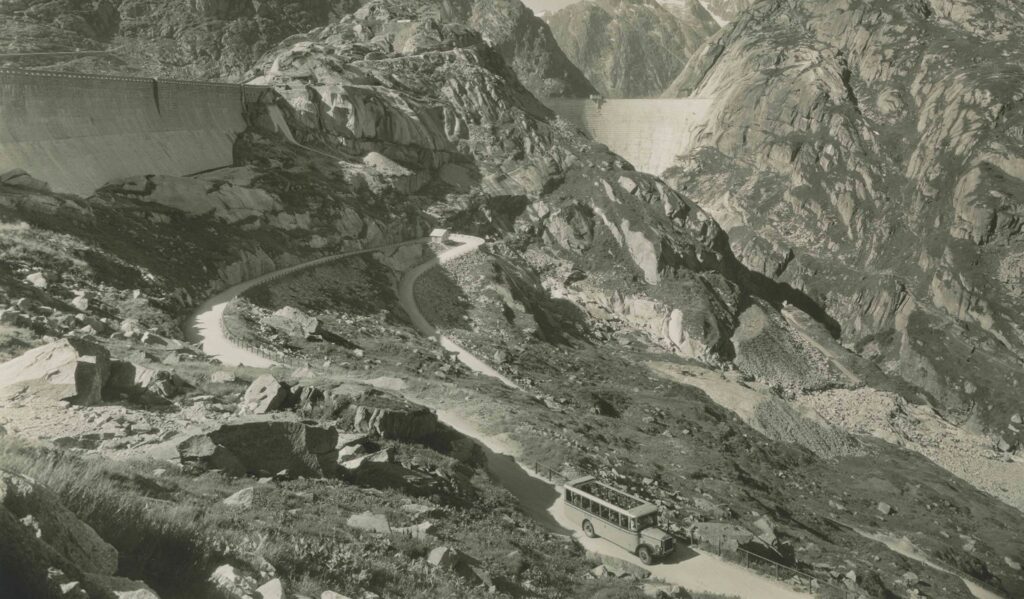
Grimsel pass road, in the background the “Posthüttlicher” and the two dams Spittallamm (right) and Seeuferegg (left)
History of the old Grimsel Hospiz
The first Hospiz was probably a medieval foundation of the Lazarites (they owned the church in Meiringen) or the Augustinian monastery in Interlaken.
1397: First documented mention
The Hospiz serves to secure the trade route over the Grimsel. A contract is concluded between the city of Bern and people from the Bernese Oberland, Upper Valais, Pommat and Eschenthal to expand and secure the route over the Spital an Grymslen (and on over the Griess Pass). This means that a “hospital”, i.e. a shelter and lodging house, already existed at this time.
1474: “Bättelbrief” (in the state archives)
Before the Reformation, the Hospiz is probably inhabited by monks. After the Reformation, the Oberhasli countryside elects a caretaker (Spittler). He must accommodate needy travelers free of charge. In winter, he was allowed to collect donations for upkeep by means of a “Bättelbrief”. However, this collection is banned again due to fraud.
1544: Bad hostel
The chronicler Johannes Stumpf reports on the Grimsel Hospiz: “It’s a bad hostel, but you can generally find good wine there, which the sojourners bring over the mountains from Eschental and Walliss…”. Card games and drinking to excess are part of the Grimsel Hospiz at this time.
1547 – 57: Remodeling
First known major remodeling of the Hospiz with several extensions.
1799: Rebuilding
The Grimsel Hospiz is in poor condition after the turmoil of war and is more or less rebuilt.
1822: Enlargement
The Grimsel Hospiz is enlarged by the then Spittler Jakob Leuthold (spacious dining room and 15 bedrooms). “A stone staircase leading from the outside to the first floor gave the whole building a more pleasing appearance”.
1838: Avalanche
The Grimsel Hospiz is buried by an avalanche, the roof is torn away and all the rooms except that of the Grimselknecht and his dog are filled with snow. “When it was rebuilt, the Hospiz was given a tower-like porch made of granite blocks on the side facing the top of the pass as a snow breaker, the lower part of which can be seen as far as the Grimselsee dam.”
1852: Fire
The tenant at the time, Peter Zybach, has the Hospiz set on fire by his winter servants, fearing that his contract would not be renewed. The fraud is quickly uncovered and Zybach is sentenced to death. Zybach is pardoned, however, and is first imprisoned in chains and then banned from the country for 20 years. The Zybach case becomes known throughout Europe.
1853: Reconstruction
The Hospiz is rebuilt and is given more or less its old appearance. Various additions and extensions follow until 1902.
1902: Conversion to Grimsel Hospiz
The Grimsel Hospiz is sold together with the Handeck inn to E. Liesegang-Perrot (private individual) and converted into a mountain inn.
1909: Sale
The company Bernische Kraftwerke (BKW) acquires the entire Grimsel property for the purpose of building a reservoir in the Aarboden.
1925
The BKW project is approved in the Bernese referendum.
1928
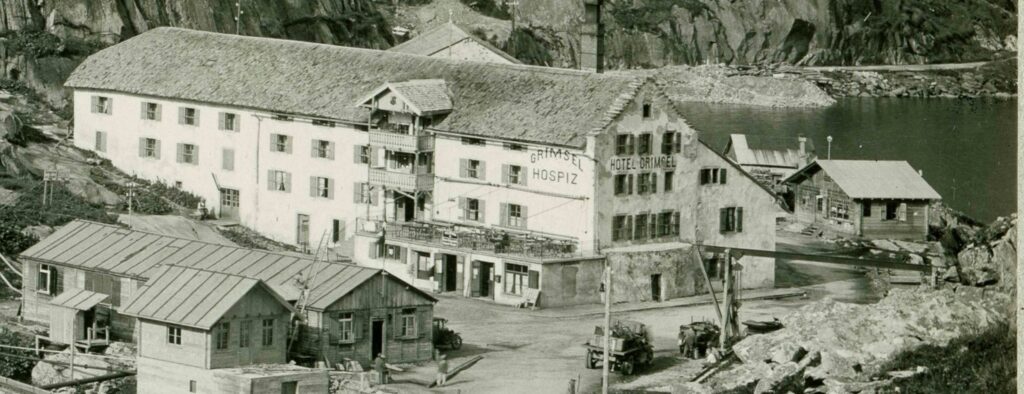
The old Grimsel Hospiz sinks into Grimselsee.
History of the new Grimsel Hospiz and Power plants
1906: Acquisition of concession
The Bernese Power plants (BKW) acquire the concession to exploit the hydropower of the Aare. A precipitation and discharge monitoring service is set up, which provides valuable data for the subsequent development of the concession project.
1920: General concession project
The Narutowicz Bureau, taking into account the geological report by Prof. Alb. Heim and P. Arbenz, draws up a project which later serves as the basis for the studies by A. Kaech and the three-stage “Project 1922”.
until 1924: Elaboration of the project
The 1st barrage comprises Grimselsee with the two Staumauern Spitallamm and Seeuferegg dams as well as the more than 5 km long connecting tunnel to Gelmersee, which is also dammed to form a barrier and serves as another water reservoir. The project is exhibited at the KABA in Burgdorf in 1924; the project author is chief engineer A. Kaech from BKW. The project is submitted to a commission of experts and approved.
1925: Founding of a public limited company
Kraftwerke Oberhasli AG (KWO) is founded on June 20, 1925.
Government bond
On April 25, 1925, the Canton of Berne approves a government bond of 12 million francs for the KWO by means of a vote.
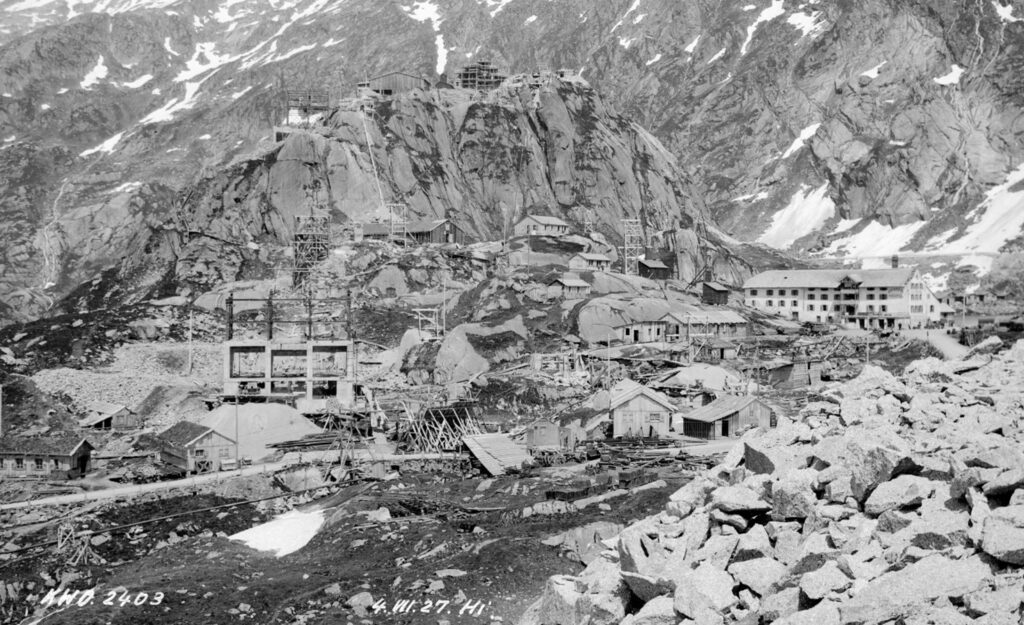
Status 1927
Construction of the 1st stage: gravel processing and concreting plants, plus pre-sorting and stone crushing plant. The sorting plant and the silos for sand, gravel and cement, as well as the concreting plant, are housed in a large iron-framed building at the top of the NW slope of the Grimsel-Nollen. Four large concrete mixers for the construction of the Spitallamm dam are enthroned on the summit of the Nollen. The concreting work for the dam wall at Seeuferegg has begun. The dam wall at Gelmersee has been completed. The material is transported by Funicular Railway Handeck. “For all the building structures, the construction management exercised great practicality with the most durable execution in granite masonry for the visible surfaces and reinforced concrete for the internal structures.”
1928: ‘Festival of Labor’
Ludwig von Roll’sche Eisenwerke AG Gerlafingen (later Von Roll AG) stages a festive event. A. Kaech points out that for the first time, only products from Swiss industry were used for all important parts of the installations, not foreign brands.
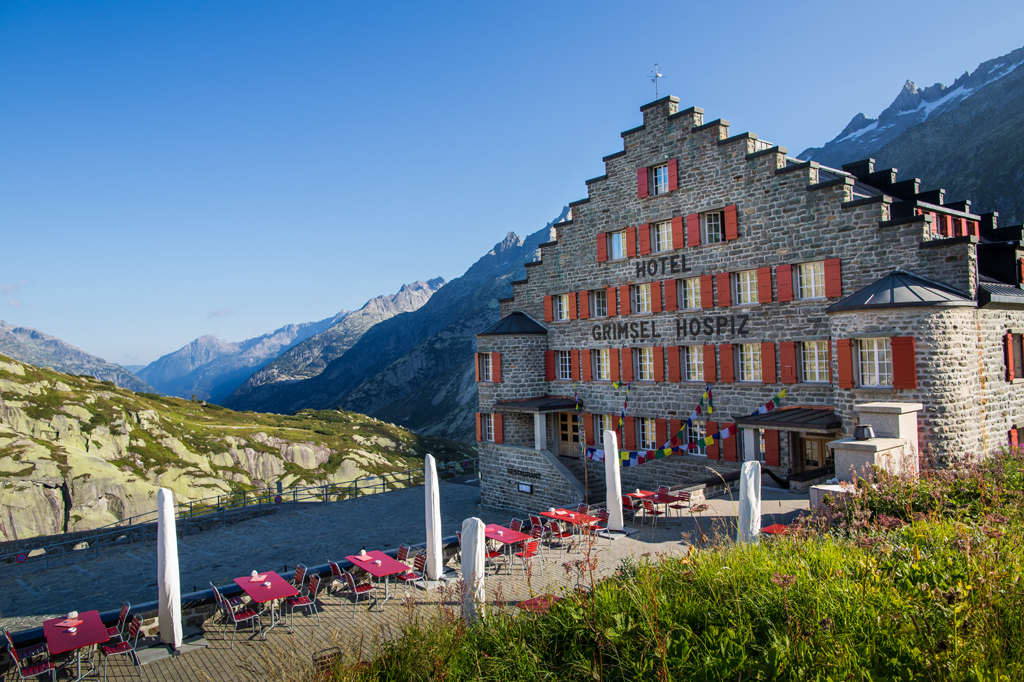
The shell of the new Grimsel Hospiz is completed.
1934
“The new Grimsel Hospiz has no organizational relationship to the plant, but the replacement of the old Hospiz with a new building was one of the conditions imposed when the concession was transferred. The new building no longer has the venerable character of the old pass hostel; it has become a luxury hotel adapted to the tastes of car travelers. Especially in the magnificent natural surroundings of the high mountains, one is doubly sensitive to all the effects of the design and even the two round oriels in front of the building appear to be a somewhat playful blurring of the cubic form. Incidentally, the hotel’s appearance, to which the architect was obliged, is relatively discreet on the outside and overall the building mass on the avalanche-proof Nollen is “well planned”. – The frequent beveled window reveals, as in the Engadine house, are apparently due to the thickness of the granite walls. “All guest rooms are paneled with fir wood, have cork flooring, electric heating, running water…the lower hall and the restaurant also have fir paneling…stairs covered with rubber”. “The masonry and the tin roofs require meticulous workmanship, as the immense wind force of the high mountains drives rain and snow into the most inconspicuous joints”. “The architect is not responsible for the Persian carpets, which are very out of place here.” “Hall and dining room entirely paneled with Swiss stone pine. An ingenious lighting system enables the most diverse lighting effects, which a traveling public spoiled by the cinema obviously cannot do without even here”.
Quotes from the document “The Work”
2007 – 2009: Renovation
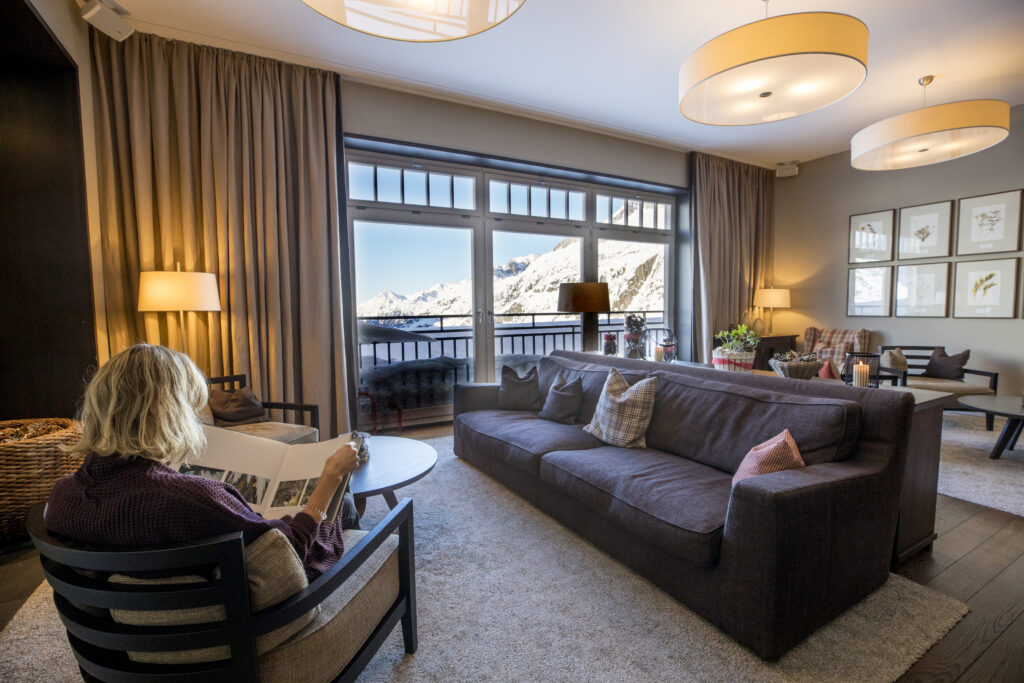
The Grimsel Hospiz is gently renovated by architect Andrin Schweizer in consultation with the monument preservation authorities. The buildings on the Nollen are reduced in size in favor of nature conservation and the BLN conservation area (Federal Inventory of Landscapes and Natural Monuments of National Importance). For conservation reasons, the façade will be renovated in such a way that its appearance is not altered. The history of the building will be preserved in all rooms and halls. The entire building is heated in an environmentally friendly way using waste heat from electricity production.
2010: Winter rest oasis
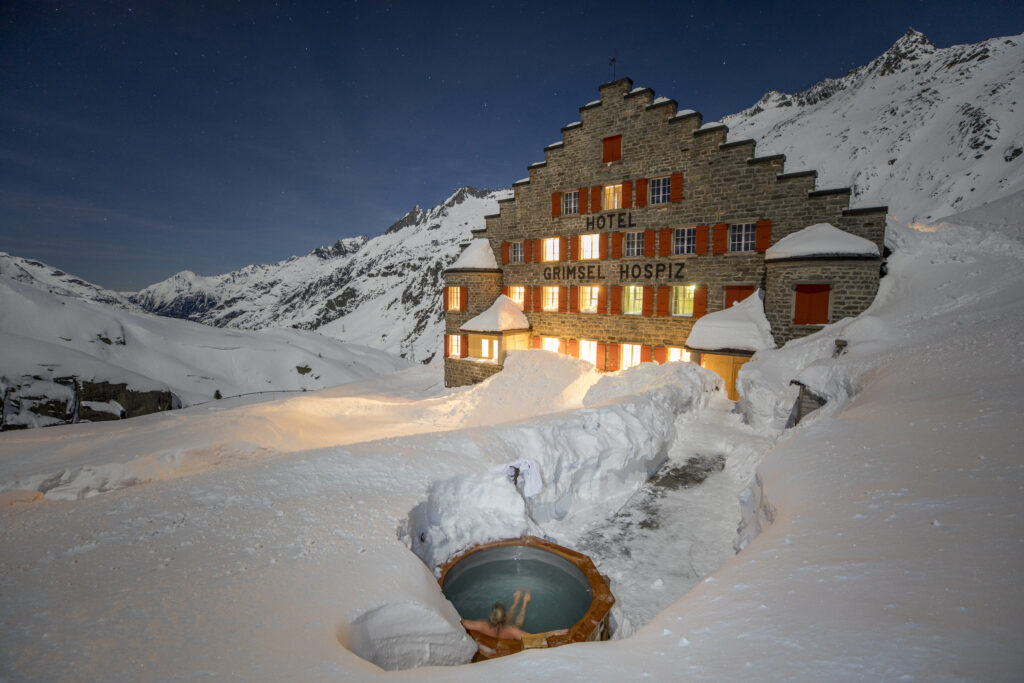
For the first time, guests spend the night in the Grimsel Hospiz winter rest oasis.