Art&Grimsel

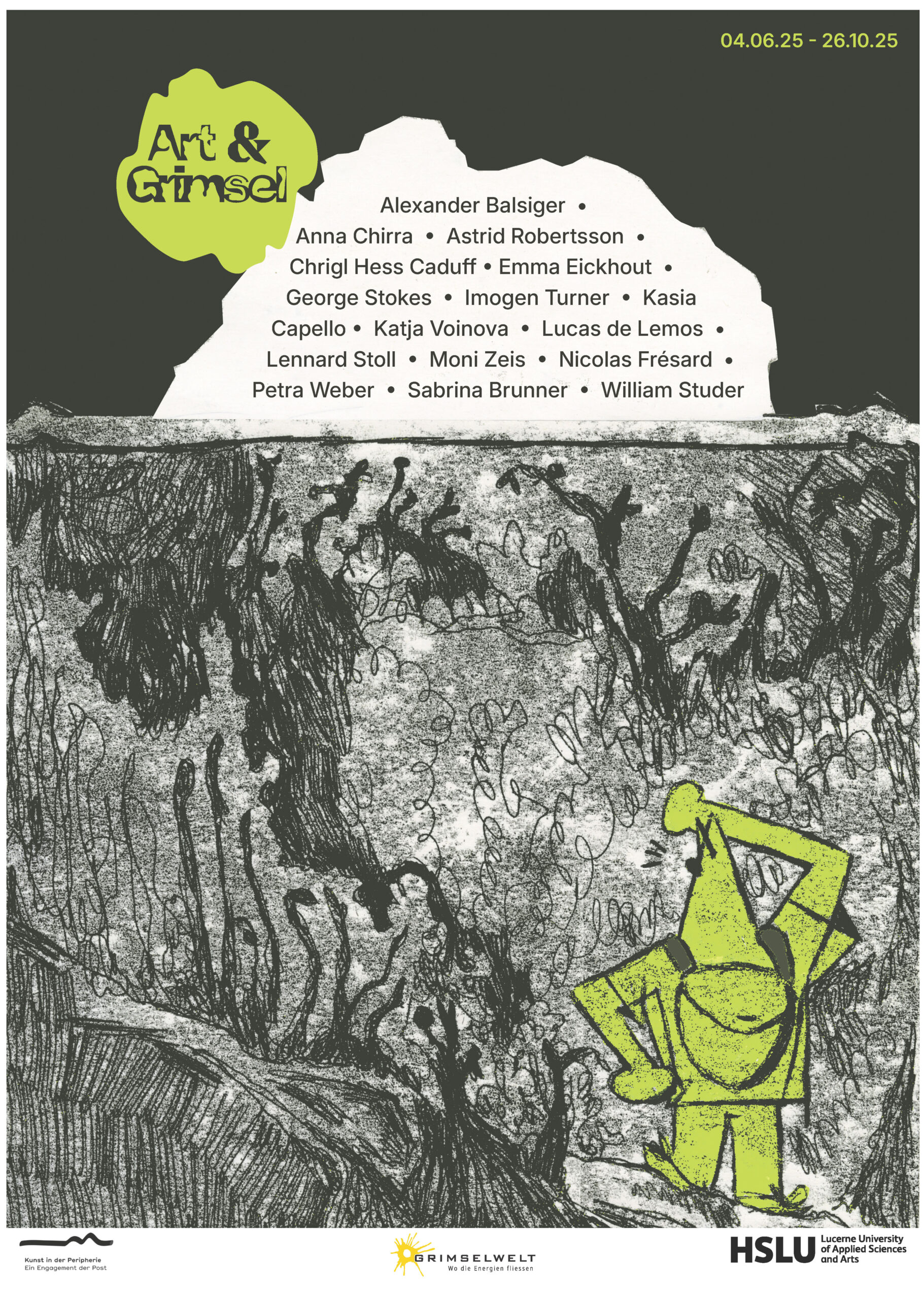
A circular route with works of art by students of the HSLU Lucerne University of Applied Sciences and Arts.

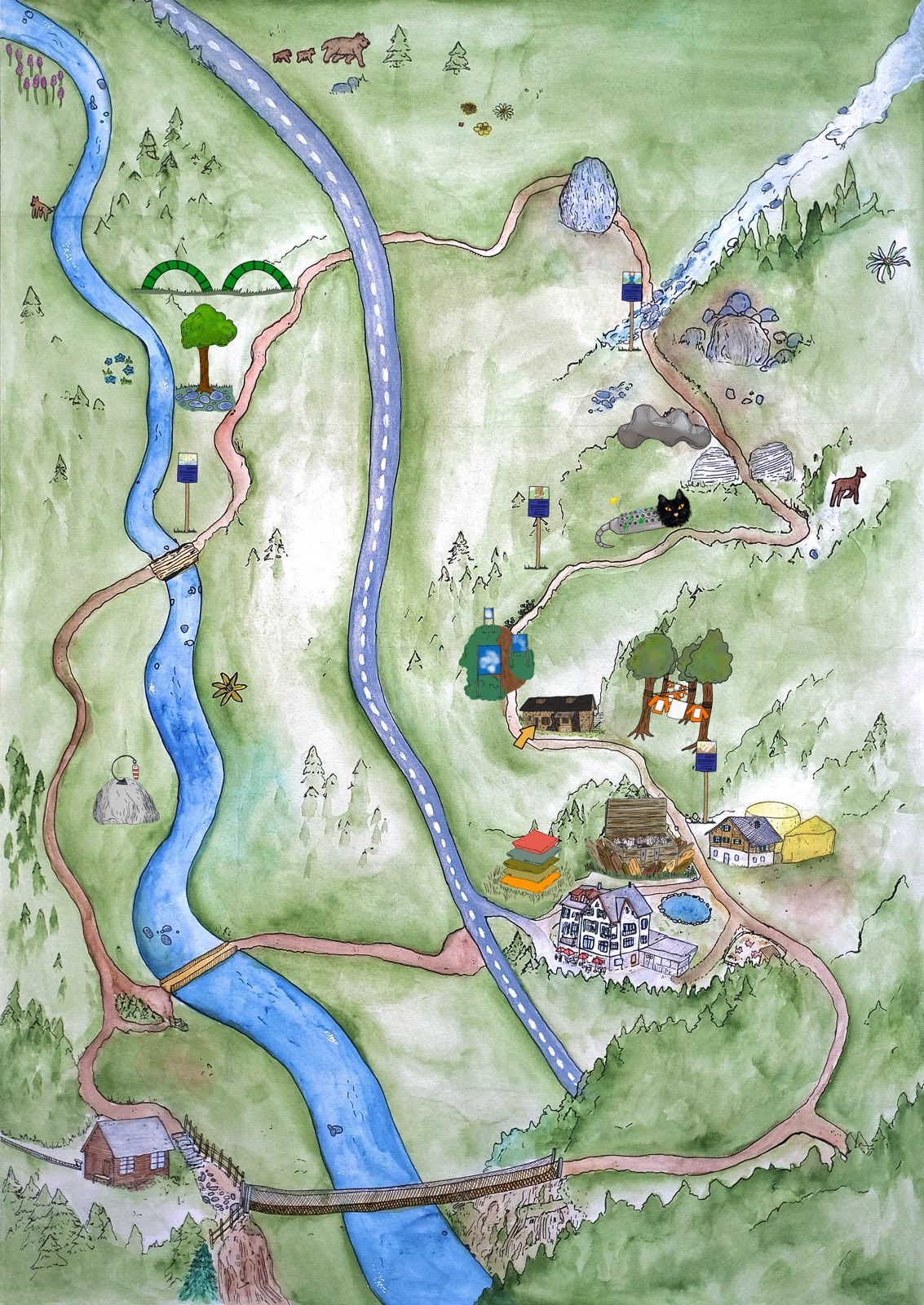
Start and finish at Hotel Handeck.

Free of charge.

Art & Grimsel is taking place for the second time since 2023 and presents artistic interventions along a hiking trail in the middle of the impressive Grimselwelt. Students of HSLU Design, Film, Art were invited to explore this unique environment – a place where nature and technology merge in a special way.
The resulting works reflect themes such as hidden treasures, work clothes, cloud formations and other facets of life above and below ground. They invite you on a journey of discovery through a landscape in which man, nature and energy engage in an exciting dialog.

Art & Grimsel presents artistic interventions along a hiking trail set within the striking landscape of the Grimsel region. Students from the Lucerne University of Applied Sciences and Arts – were invited to explore this unique environment, where nature and technology intertwine in remarkable ways.
The resulting works reflect on themes such as hidden treasures, workwear, cloud formations, and other aspects of life both above and beneath the surface. They invite visitors on a journey of discovery through a landscape where humans, nature, and energy engage in a compelling dialog.

Managed by :
Sebastian Utzni
Céline Brunko

A collaboration between
HSLU, Grimselwelt and KWO

Work from :
Alexander Balsiger
Anna Chirra
Astrid Robertsson
Chrigl Hess Caduff
Emma Eickhout
George Stokes
Imogen Turner
Kasia Capello
Katja Voinova
Lucas de Lemos
Lennard Stoll
Moni Zeis
Nicolas Frésard
Petra Weber
Sabrina Brunner
William Studer

Zones of Connection

Lucas de Lemos
Set within the powerful landscape of Grimsel, where water is transformed into electricity, Art&Grimsel 2025 - Zones of Connection explores another form of energy: the subtle, regenerative power of nature on the human body and spirit. Through four immersive zones-the Grounding Zone, Breathing Zone, Hugging Tree Zone, and Feet in Water Zone-visitors are invited to slow down and tap into the earth's natural energies. Each zone engages the senses and nervous system, offering a quiet, embodied experience of renewal. The installation highlights how the land not only powers machines, but also restores human vitality. By aligning with the rhythms of the alpine environment, Art&Grimsel 2025 reconnects us to the energetic balance between nature, technology, and ourselves.

Light on fabric

Sabrina Brunner
The KWO textiles are coated with cyanotype - a light-sensitive emulsion that develops under UV radiation. Materials found on and near the hiking trail are placed on the fabrics. After a short exposure time in the sun, the emulsion reacts on the textile. The exposed fabrics are taken to the washing machine protected from light. There, the reaction with water produces the typical blue color of the cyanotype. Areas that have not been exposed to UV light remain lighter or white, the emulsion could not develop in these areas and is washed out. The result is an abstract series of cyanotypes on textile, which can be found among the blueberry bushes.

Cyanotype on textile, 110 cm x 160cm

Dragon

Emma Eickhout, George Stokes, Imogen Turner
Inspired by the underground pipes that pump the water for Grimselwelt's hydropower, as well as the folklore of the Stollenwurm; "The dragon of the mine- tunnels", which has a snake-like body and originates from the Bernese Alps.

Inspired by the underground pipes that pump the water for Grimselwelt's hydropower, as well as the folklore of the Stollenwurm; "The dragon of the mine- tunnels", which has a serpent-like body, originating from the Bernese Alps.

Wood, Metal and Fabric; 4m x 2.5m (x2)

Wall stones

Nicolas Frésard
Deep in the mountain tunnel at the Crystal cave Gerstenegg, a local quote is written in simple words:
"Take a stone in your trouser bag and düü bischt nee mee chrank."
A sentence that invites you to open your eyes, search for special stones - and carry them with you for a while. In an area characterized by impressive rocks and hidden crystals, a silent dialogue is created between man and mountain.
There is a wooden chest by the side of the path. She collects these stones. If you like, you can take one with you on the hike and put it back afterwards. You are also welcome to add your own finds to the collection.
The chest was built with old wood from the KWO's Power plants and workshops and measures 60 cm in length and 40 cm in width. It rests on the wooden remains of the work underground and wood from the beautiful Grimselwelt.

stray from the path

Katja Voinova
vom weg abkommen is a textile work that arose from an examination of exhaustion in everyday life. The color design takes inspiration from the variety of lichens that cover the stones of the Grimselwelt as well as the strongly noticeable presence of the hydroelectric power plant in nature. A zine accompanies the work.

If you can't see the forest for all the emails, then walking can also feel like a to-do. You may be walking along the path, but the beauty of the forest passes you by unnoticed.

To stray from the path is an invitation to stop. Take a cushion with you on your walk and decide at some point to leave the path and stay somewhere.

6 seat cushions approx. 40x40cm, screen print on cotton canvas, used workwear from Grimsel Hydro, zine riso print

learn from Monsters to survive

Anna Chirra
She only knew the subsoil
Her nails are made of roots, which dig the earth the time has come for her to go out to the surface,
the time is now
The creature needs thistle to survive
And there are no flowers underground
The colors are where the sun lights them up
It now rests in a place that humans have abandoned
Waiting to find that flower, in order to feed on his resilience and his love Monsters also need to see Flowers
Monsters also need to learn to love
Learn from monsters to survive ..


Dimension: 1.50 cm × 50 cm ~ jute bags; roots; wire; dried thistle flowers; stones; wood; fabrics

Cumulus

Petra Weber & Lennard Stoll
Cumulus explores the paradox between materiality and perception - made of heavy steel, it takes on the ethereal, ephemeral form of a floating cloud. The sculpture embodies a tension between the weight of the material and the visual lightness it evokes. The work is inspired by the Grimselwelt, where monumental Alpine landscapes meet artificial reservoirs. Just as the Grimsel dams store huge quantities of water behind their concrete facades, the clouds serve as natural reservoirs that absorb and release water in ephemeral cycles. By referencing the solidity of the mountains and the ephemeral softness of the clouds, Cumulus becomes a metaphor for balance and duality - between nature and technology, permanence and impermanence, heaviness and lightness.

Steel, approx. 200 x 100 cm

Wind change I

Chrigl Hess Caduff & Alexander Balsiger
Wind Change I" is written on a massive boulder and visualizes the movements of the wind. The wind goes downhill, the wind goes uphill and the wind stands still. Just as the muleteers once did. On the opposite side of the Aare - within sight - runs the former mule track and current hiking trail "Via Sbrinz 40", which has connected central Switzerland with northern Italy for centuries.

The Wash

Kasia Capello
The Wash is not a monument, but a trace. Installed dimensions variable, site-specific. Mixed media with pigment and screen-printed images.

The Wash is part of an ongoing series of installations by Kasia Capello, exploring the passing of time, fragility, and change. Installed between trees, it consists of two abstract acrylic paintings on canvas (160 × 250 cm each), five workers' jackets, and two sheer curtains. The materials are exposed to the weather over time-inviting wind, rain, and decay to act as collaborators.

The jackets suggest work once done, or never finished. The curtains drift, veiling and revealing. The paintings absorb stains, watermarks, and silence. Nothing is protected. Everything is placed to be marked. The Wash presents a state of transition. It listens. It holds. It slowly disappears.

Subsurface

Astrid Robertsson
The relationship between nature and industry is integral to the history and culture of Grimsel. Cyanotype exposures of photos taken in Grimsel , mostly underground are exposed onto recycled cotton which has then been adhered onto the rocks and weatherproofed. In this the nature and industry blend.

approx. 2x0.25 m, rocks, recycled cotton fabric, cyanotype chemicals, boat varnish

Stollen worm

William Studer
This sculpture is my interpretation of an old legend from the Bernese Oberland. The so-called Stollenwurm is said to have been a mixture of snake and animal - with short legs, a round head and dangerous for livestock.

I built it from old metal parts, some of which are things that would otherwise be thrown away. The structure is reminiscent of a plant or an animal, but is technical at the same time. I am interested in how old stories can live on - even in new materials. For me, the tunnel worm is a creature between nature, technology and imagination.

Iron; 100 × 40 cm

Mermen

Moni Zeis
The mermen are not all of one kind. There are also evil ones who do more harm than good. Such ones used to live in the Furrenfluh near Guttannen on the Grimselstrasse. They stole children, stalked beautiful girls and locked them in their caves so that they could never return to their own. Once, however, this was bad for a little water sprite. In pursuit of a girl from Guttannen, she was severely chastised by her rushing lover, and when she cried out for protection, she was mockingly dismissed with the local saying: "Selbhan, Selbhan". From that time on, this little water sprite kept the mocking name "Prince Selbhan".
Presumably, however, the mermen in that region were not so evil from the beginning, they must have become so only later; for it is still said today that, as elsewhere, they used to feed the cows there too. Such a rhyme is still known to every child there today. It is called: "Good Hans von Weissenfluh, Take your cow again and her fat calf too!"

mixed media, 1m

Tour